
Swim Meet 101
Heat Sheets
For those that are beginners to the sport of swimming, Heat Sheets are a bit overwhelming. With that in mind, we want to put you at ease. Reading a heat sheet is not as bad as you think. So... let’s dive in. (pun intended)
First of all, we need to address the question... What is a Heat Sheet?
A heat sheet is the program for a swim meet. It list all the events that are going to be swam. It list the swimmers in each race (or event). It tells us the heat and lane that the swimmer will need to be in for their race (or event).
Did we just throw out too many terms? Let’s define our terms to make it easier to understand.
When we talk about the pool area, we use the term deck. The pool deck is the area that surrounds the actual pool.
The pool itself is divided into lanes. Each lane is designated by a number. Typically lanes 1-6. The lanes are separated by lane lines (floaty ropes connected to each end of the pool).
Let’s talk about events. Events are listed by a #. The official will call for swimmers to line up for “Event # xx”, whatever the event number is. The official name of the event is spelled out beside the number of the event on the heat sheet. Ex. Event #xx boys 9-10 25 yard freestyle.
Next lets talk about heats. Depending on the number of swimmers in an event, an event might have multiple heats. A “heat” is the group of swimmers swimming in the pool at the same time. If there are more swimmers in an event than lanes to swim in, we need to create multiple heats (or groups) for that event. Ex. an event might have 10 swimmers total combined from each team. Only 6 can swim at one time due to only having 6 lanes. 2 heats would need to be swam with 6 in heat 1 and 4 in heat 2 to complete the full event.
OK, now that we have some terms down, let’s move on. Back to the heat sheet...
When you look at a heat sheet, you realize how much info is there. The good news is, the greater part of all that info is only 3 or 4 parts that we really need to know.
The Event #, heat # and the lane# to swim in.
Heat Sheet Sample
Below is a sample heat sheet. In the next section Example we will use event #13 to learn how to read the a heat sheet. Click here to download this sample heat sheet

Example

In the picture above, let’s use Laniyah as our example. (She is highlighted in yellow)
She is swimming in the Event Name “Girls 8 & Under 25 Yard Freestyle”
the “event” is #13.
The “heat” is #2
The “lane” is #6
The Event Name gives you the description of the event.
"Girls or Boys / Age Group / Distance to swim / Type of stroke being swam"
One length of the pool is measured as 25 yards (or sometimes 25 meters)
Grids for Swimmers
Now that you know how to read the heat sheet, let’s talk about how to keep your swimmer ready for their events.
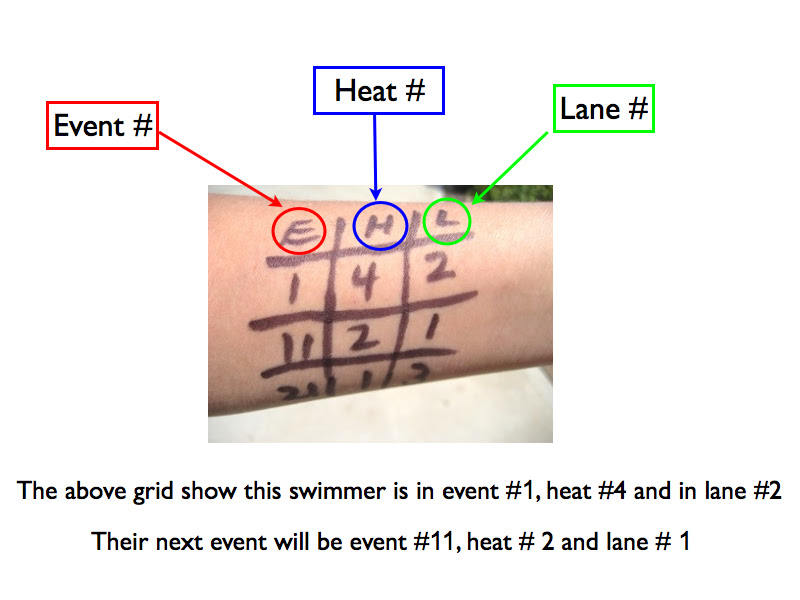
This is really easy. Simply draw a grid (like a tic-tac-toe board) on your swimmers arm.
(usually with a sharpie pen) With the 3 numbers that we talked about above, we write those #’s in the grid and ta-da!!!, your swimmer now knows exactly when and where they need to be for their events.


Swim Meet Volunteer Opportunties
Swim meets can’t run without the help of volunteers! Whether you’re a seasoned swim parent or brand new to the sport, there’s a role for everyone. Volunteering is a great way to support your swimmer, meet other families, and help the team succeed.
Announcer
The announcer is the voice of the swim meet. This person starts the meet, keeps everyone informed, and helps things run smoothly. Responsibilities include:
- Announcing the start of the meet and welcoming participants.
- Calling swimmers to the blocks for each event and heat (e.g., "Event 12, Heat 3, please step up").
- Giving commands such as “Swimmers, step up,” “Take your mark,” and signaling the start with a whistle or other cue (depending on the meet setup).
- Keeping the crowd informed of event progress, schedule changes, or other important information.
Set-Up Crew
Before the meet begins, the set-up crew prepares the pool area and surrounding spaces. Tasks may include:
- Setting up lane lines, starting blocks, backstroke flags, and timing equipment.
- Arranging tables and chairs for timers, computer operators, and coaches.
- Setting up tents, signs, and volunteer stations.
- Ensuring stopwatches, clipboards, and pencils are at each timing station.
Clean-Up Crew
After the meet ends, this team is responsible for returning the facility to its original condition. Tasks include:
- Taking down lane lines, flags, tents, and other equipment.
- Packing up supplies like stopwatches, chairs, and tables.
- Throwing away trash and ensuring the pool deck and surrounding areas are clean.
- Assisting in loading items into storage or vehicles if needed.
Computer Operator
These volunteers manage the recording of swimmer results using a swim meet management software. Usually handled by two people splitting the meet (e.g., odd/even events or first/second half). Responsibilities:
- Entering swimmers’ times from the timing sheets into the computer accurately.
- Verifying correct event, heat, and lane for each result.
- Printing and posting results if needed.
- Communicating with the head timer or runner if there are missing or unclear times.
Runner
The runner serves as the link between the timers and the computer operators. After each race:
- The runner collects time sheets or lane slips from each timer.
- Delivers the collected sheets to the computer table for data entry.
- May also deliver disqualification (DQ) slips or other forms between officials.
Staging Area Coordinator
The staging coordinator helps swimmers get into the correct order before their race. Duties include:
- Checking heat sheets to see who is swimming in each heat.
- Calling swimmers to the staging area in advance.
- Organizing them into correct lanes and heats before they move to the blocks.
- Ensuring younger or newer swimmers are in the right place at the right time.
Volunteer Check-In
This person helps other volunteers get started. Responsibilities include:
- Greeting volunteers as they arrive.
- Checking them in and confirming their role assignments.
- Giving directions to their job location (e.g., “Timers go to lane 1–6, staging is behind the blocks”).
- Answering questions or helping fill last-minute gaps.
Timer
Timers are essential to the meet, as they provide each swimmer’s time for their race. Typically, two or three timers are assigned to each lane. Responsibilities include:
- Starting the stopwatch at the start signal.
- Stopping the watch when the swimmer touches the wall at the end of their race.
- Recording the swimmer’s time on a time sheet.
- Handing the completed time sheet to the runner.
Stroke and Turn Judge (Certification Required)
This official ensures swimmers are following the rules for each stroke and turn. Responsibilities include:
- Watching each swimmer to ensure strokes (e.g., butterfly, breaststroke) and turns are performed legally.
- Reporting any violations (e.g., incorrect turn, early start) to the referee.
- Writing disqualification slips when necessary.